Click, Clack, Cash: How Vintage Keyboards and Mice Went From Office Junk to Status Symbols
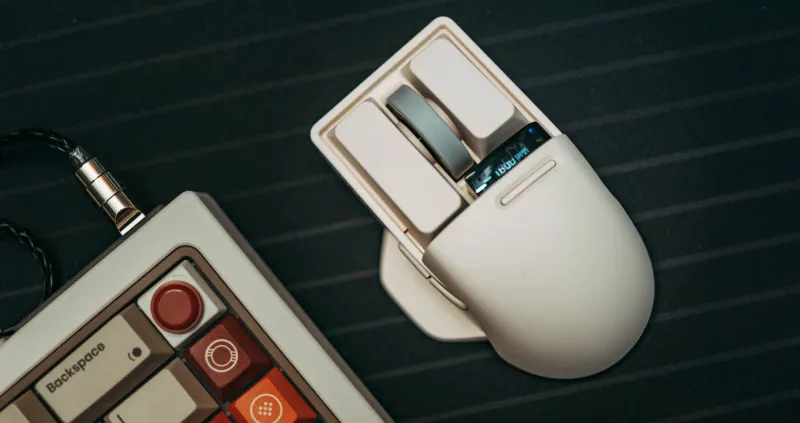
For most of the 2000s, people couldn't get rid of old computer peripherals fast enough. Chunky keyboards got tossed. Big-ball mice went to the Goodwill bin. Trackballs — those weird, upside-down-looking pointing devices that office workers either swore by or couldn't figure out — ended up in landfills by the millions. Nobody thought twice about it.
Fast forward to today, and those same devices are selling on eBay for prices that would make your jaw drop. A vintage IBM Model M keyboard in good condition? Easily $100 to $300, sometimes more. An original Apple ADB mouse from the late '80s? Thirty to sixty bucks, depending on condition. A Kensington Turbo Mouse trackball from the early '90s? Collectors are regularly paying $150 or more for a clean one.
Something shifted. And it's worth understanding exactly what.
The Mechanical Keyboard Revolution Has Deep Roots
The modern mechanical keyboard hobby — and it is absolutely a hobby, complete with forums, group buys, and a vocabulary that takes months to learn — didn't come from nowhere. It grew, in large part, from people rediscovering old keyboards and realizing that nothing made since had come close to matching them.
The IBM Model M, manufactured from 1984 onward, is the canonical example. Its buckling spring switches produce a tactile bump and an audible click that modern keyboard enthusiasts have spent decades and billions of dollars trying to replicate. The thing was built like a tank — steel backplate, thick keycaps, a weight that tells you immediately this was not a throwaway product. IBM made it to last, and it did. Plenty of Model M keyboards manufactured in the 1980s are still in daily use today.
"The Model M ruined me for every other keyboard," says Trevor Oakes, a software developer in Seattle who collects vintage input devices alongside his daily-driver setup. "Once you type on one, the membrane keyboards that came after feel like pressing on wet cardboard. There's no going back."
Beyond the Model M, the collector landscape includes the Apple Extended Keyboard II (beloved for its Alps switches), the original IBM PC keyboards, and various Japanese-market boards from Fujitsu and NEC that used switch types never widely seen in the US. These latter pieces — particularly the Fujitsu Leaf Spring boards — have become something of a holy grail in keyboard collecting circles, with prices that reflect their scarcity.
Mice With History
If keyboards are the headliners, vintage mice are the underrated supporting act. Apple's early mice are the most recognizable to a general audience — the single-button, hockey-puck-adjacent designs that shipped with Macs from the early '80s through the late '90s carry real nostalgia weight. The original Apple Lisa mouse and the boxy Apple Desktop Bus Mouse are particularly sought after, both as functional pieces and as design objects.
But the collector world goes much deeper than Apple. Microsoft's original IntelliMouse series, Logitech's early trackball mice, and various OEM mice from the DOS era have all developed followings. Condition matters enormously — yellowing plastic (a common fate for beige-era hardware) can reduce value significantly, though some collectors actually seek out pristine examples of the yellowing as authentic period detail.
"There's a whole subset of collectors who specifically want unrestored, original-condition pieces," notes Priya Mehta, an industrial designer and vintage tech enthusiast based in San Francisco. "They're not interested in retrobrighted plastic. They want the thing exactly as it left someone's desk in 1993. That authenticity is the whole point."
Trackballs: The Weird Ones Win
And then there are the trackballs. If keyboards are the mainstream entry point and mice are the accessible middle ground, trackballs are where things get genuinely niche — and genuinely expensive.
Kensington's Turbo Mouse and Expert Mouse lines, which dominated the professional Mac market in the late '80s and '90s, are the blue-chip trackball collectibles. These were premium products when new — the kind of thing you'd find on a graphic designer's desk at an ad agency — and they've aged into genuine status symbols. The large ball, the satisfying scroll ring, the build quality that makes modern peripherals feel disposable: it all adds up.
Beyond Kensington, there are Logitech's early trackman series, the Marble Mouse, and various obscure OEM trackballs that were bundled with specific computer systems and are now nearly impossible to find. Hunting for these pieces — cross-referencing old catalogs, digging through estate sales, monitoring specialized forums — is half the fun for serious collectors.
Function Meets Fashion
Here's what separates the vintage peripheral market from some other collecting niches: a lot of these items are still being used. Not just displayed — actually plugged in and typed on every day.
The mechanical keyboard community in particular has built an entire aftermarket around keeping vintage boards alive. New replacement cables, custom keycap sets designed to match period-accurate colorways, USB adapters for older connectors — the infrastructure for using vintage keyboards as daily drivers has never been more robust.
This dual identity — collectible artifact and functional tool — gives the vintage peripheral market a stability that pure nostalgia collecting sometimes lacks. When a $200 Model M is also the best typing experience you can get for that price, the purchase is easier to justify. When that original Apple mouse looks incredible on your desk and still works perfectly, it's both display piece and conversation starter.
What to Look For Right Now
For anyone looking to get into this space, the advice from experienced collectors is consistent: don't sleep on Japanese-market hardware. Boards and peripherals sold in Japan during the late '80s and early '90s were often built to higher tolerances and used switch types that never made it to the US market. They're undervalued relative to their quality and getting harder to find.
Also worth watching: early Logitech trackballs, vintage Apple mice in original packaging, and anything with original documentation. As with most retro tech, the box and paperwork can double or triple the value of an otherwise common piece.
The RetroVault bottom line: these aren't just old office supplies. They're the physical interface between humans and the digital revolution — the actual tools that people used to build the internet, write the software, and design the graphics that defined an era. That's worth a lot more than a spot in the recycling bin.