The Little Blue Box That Ran the Internet: Why Early Routers Are Suddenly Worth Collecting
For most of us, the home router was just a blinking annoyance — something you kicked when Netflix froze or rebooted at midnight when the Wi-Fi died. It sat on a shelf, collected dust, and eventually got tossed in a junk drawer or donated to Goodwill without a second thought. But here's the thing: a growing community of collectors has started looking at those same devices with completely different eyes. To them, a factory-boxed Linksys WRT54G or a mint-condition Netgear MR814 isn't garbage. It's a time capsule.
And depending on the condition, it might actually be worth something.
The Golden Age of the Home Network
Cast your mind back to the early 2000s. Broadband internet was rolling out across American suburbs like a slow, beautiful wave. DSL was replacing dial-up. Cable modems were showing up in Best Buy flyers. And suddenly, families needed a way to share that precious connection between multiple computers — because yes, your family had multiple computers now, and that felt absolutely futuristic.
Enter the consumer router. Companies like Linksys, Netgear, D-Link, and Belkin rushed to fill that need, and they did it with hardware that had a very specific visual language: plastic shells in shades of deep blue, corporate gray, and that particular shade of cream that only existed in early-aughts electronics. Antennas that swiveled. Status lights that blinked in patterns you memorized like a second language. And boxes — glorious, information-dense boxes — covered in clip art-style illustrations of houses with wireless signals radiating outward like a promise of the future.
That aesthetic is exactly what collectors are chasing right now.
Why the Packaging Matters as Much as the Hardware
If you've spent any time in retro tech collecting circles, you already know that condition is everything — and that "in box" means a completely different tier of desirability. The same principle applies here. A loose Linksys WRT54G is a fun display piece. A sealed, never-opened WRT54G with the original CD-ROM, Ethernet cable, and setup guide tucked inside? That's a different conversation entirely.
The packaging from this era tells a specific story about how the industry wanted to sell the idea of home networking to regular American families. There's something almost endearing about those box illustrations — the clip-art homes, the dotted-line wireless signals, the promise that "setup takes just minutes!" (Narrator: it did not always take just minutes.) The graphic design reflects a moment when tech companies were desperately trying to make complicated infrastructure feel approachable and domestic.
Collectors are responding to that sincerity. There's no irony in how these boxes were designed. They were genuinely trying to communicate something exciting, and that earnestness reads as charming decades later.
The WRT54G Problem (and Why It's Also the WRT54G Opportunity)
No conversation about router collecting can skip the Linksys WRT54G, which is basically the Fender Stratocaster of this hobby. Introduced in 2002, it ran for years with minimal design changes, sold in enormous numbers, and became the backbone of home networking for an entire generation. It also had open-source firmware potential that made it legendary in tech communities.
The irony is that its ubiquity makes truly pristine examples harder to find. Most WRT54Gs got used hard, moved around, and eventually died. Finding one in original packaging with all accessories is legitimately uncommon, which is exactly the kind of scarcity that drives collector interest. Variants matter too — early hardware revisions are more sought after than later ones, and certain regional packaging differences have started attracting the same obsessive documentation you'd see in video game collecting.
Netgear's early lineup tells a different story aesthetically. Their devices leaned into a slightly more aggressive, angular design language, with packaging that felt a little more corporate and a little less "friendly neighbor explaining Wi-Fi." D-Link occupied a middle ground, and Belkin had its own visual identity that some collectors specifically seek out for its distinct color palette.
The Millennial Connection
It's worth being direct about who's driving this trend. Millennials who grew up in households where getting the router set up was a whole event — a weekend project involving CD-ROMs, phone calls to tech support, and at least one argument about where to position the antenna — have a specific emotional relationship with this hardware. These devices weren't just tools. They were the gateway to everything: AIM conversations, early multiplayer gaming, downloading songs one at a time, staying up too late on forums.
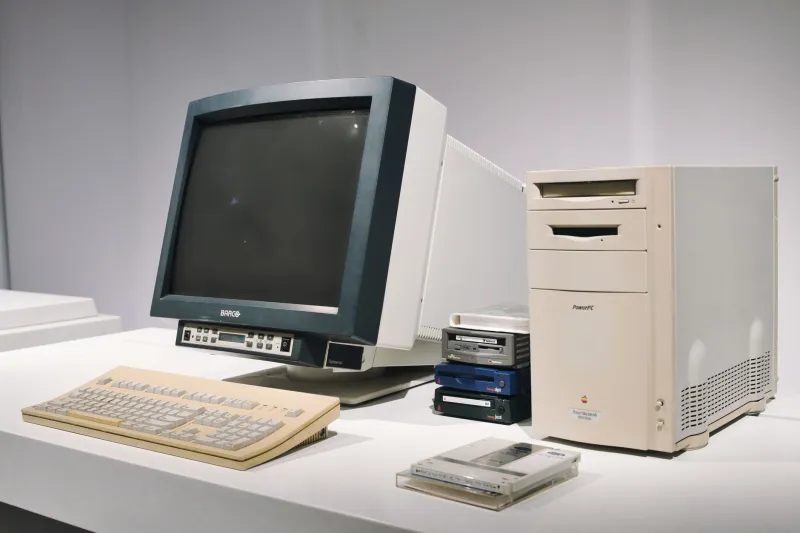
When you see a Netgear box on a collector's shelf, styled next to a vintage iMac or a stack of early-aughts PC game boxes, it's not random. It's a deliberate reconstruction of a specific moment in time, a moment that felt like the future was arriving in real time. Displaying that hardware is a way of honoring that feeling.
This is the same impulse driving interest in vintage sound cards, old ISP promo discs, and early digital cameras. The early internet era is becoming historicized, and the physical objects from that period are the artifacts that survived.
What to Look For If You're Starting a Collection
If this rabbit hole is calling to you, a few practical notes:
Prioritize original packaging. Even a beat-up box is better than no box. A sealed unit is the holy grail.
Check for all original accessories. The included Ethernet cable, the power adapter, and especially the setup CD are what make a "complete" example. Missing any of these drops the value and completeness significantly.
Know your hardware revisions. For popular models like the WRT54G, early revisions (v1, v2) command more attention than later ones. Research the version history before you buy.
Condition of the status lights matters. A unit where all LEDs still function is worth more than a dead one, even as a display piece.
Don't sleep on the less famous brands. Belkin and D-Link units from the same era are often cheaper precisely because they're less recognized — which means the floor is lower and interesting pieces are easier to find.
A Corner of the Vault Worth Exploring
Retro tech collecting has always rewarded people who look slightly sideways at the obvious stuff. While everyone else chases vintage game consoles and sealed software, the collectors who move early on underappreciated categories tend to be the ones who look smart five years later.
Early routers fit that profile perfectly. They're cheap enough right now that getting into the hobby doesn't require serious investment. They're visually distinctive enough to display well. And they carry exactly the kind of cultural weight that turns an object from junk into artifact.
Your childhood internet gateway is waiting somewhere. Somebody's going to rescue it. Might as well be you.