Ink, Noise, and Nostalgia: The Surprising Rise of Vintage Printers as Must-Have Collectibles
There's a particular sound that anyone who grew up in an American office or household during the '80s and '90s will never fully forget. That grinding, mechanical chatter of a dot-matrix printer grinding through a stack of perforated paper — the kind of noise that meant something was actually happening. Work was being done. Documents were being born. It was loud, it was slow, and it was glorious.
Fast-forward to today, and that same machine — the one your parents probably kicked under a desk and eventually hauled to Goodwill — is showing up in collector listings, vintage tech forums, and even curated home office setups for prices that would've made your 1994 self absolutely baffled. Vintage printers are having a moment, and if you've been sleeping on this corner of the retro tech market, it's time to wake up.
From Office Annoyance to Collector's Crown Jewel
For a long time, printers occupied the most unglamorous rung of the vintage tech ladder. While people were chasing down original Game Boys, mint-condition sound cards, and sealed boxed software, printers sat in storage units and thrift shops, largely ignored. They were too big to display easily, too mechanical to feel "digital," and too associated with boring office life to inspire much passion.
But that perception is shifting — and fast. A growing community of collectors, retro tech enthusiasts, and even working professionals are recognizing something that the mainstream market has consistently overlooked: vintage printers are mechanical marvels with a story to tell, and many of them still work better than the flimsy wireless models sitting on desks today.
The appeal breaks down into a few key categories: aesthetic, mechanical reliability, and historical significance. And honestly? The combination is pretty hard to argue with.
The Models Driving the Market
Not every old printer is suddenly worth a fortune, but a handful of standout machines are commanding real attention — and real money.
The Epson MX-80 is probably the most iconic dot-matrix printer ever made. Released in 1980, it became the de facto standard for home and small business printing throughout the early PC era. A fully functional MX-80 in good cosmetic condition can fetch anywhere from $150 to $400 depending on the platform and the seller. Find one with its original box and manual? You're looking at the higher end of that range, no question.
The Apple ImageWriter II is another heavy hitter. As the companion printer to the early Macintosh line, it's essentially a piece of Apple history — and Apple collectors are a passionate bunch. Clean, working examples regularly sell in the $200–$500 range, with premium units in original packaging occasionally cracking $700 on the right auction.
On the inkjet side, the HP DeskJet 500 holds a special place. Released in 1991, it was one of the first truly affordable inkjet printers for home users and helped democratize quality printing in a way that genuinely changed everyday American life. Collectors with a soft spot for early inkjet technology are picking these up for $75–$200, particularly if the print heads are still clean and functional.
And then there's the Okidata Microline series — a line of dot-matrix workhorses that were absolutely everywhere in American businesses during the '80s. They're built like tanks, and that durability is a huge part of their appeal. Working Okidata units move steadily in the $100–$300 range, often purchased by small businesses that still need to print multi-part forms — a task that modern inkjets and laser printers literally cannot perform.
The Working Machine Advantage
Here's the irony that makes the vintage printer market genuinely fascinating: a lot of these old machines are more useful in certain contexts than their modern counterparts.
Carbon copy forms. Receipt paper for older POS systems. Multi-part invoices. Continuous-feed label printing. These are real-world tasks that dot-matrix printers handle effortlessly — tasks that would make a modern wireless inkjet completely useless. There's a reason auto repair shops, shipping warehouses, and small-town diners still have ancient Epson or Oki dot-matrix printers humming away in the back. They just work, and they work for jobs nothing else can do.
For collectors, this functional dimension adds a layer that purely decorative vintage tech can't match. You're not just buying a conversation piece — you're buying a machine with genuine, demonstrable utility. That's a rare thing in the collectibles world, and it adds real justification to the price tags.
The Aesthetic Argument
Beyond function, there's a visual appeal to vintage printers that's hard to dismiss once you start noticing it. The beige and off-white plastics, the chunky mechanical buttons, the satisfying clunk of a paper release lever — these machines have a tactile and visual identity that modern printers, with their glossy black plastic and touch screens, simply don't. They look like they mean business in a way that feels honest and unpretentious.
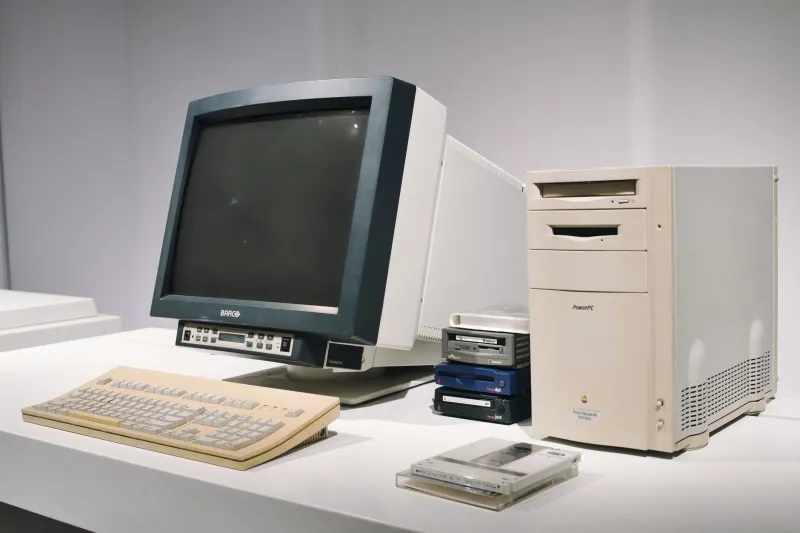
A growing number of collectors are incorporating vintage printers into retro home office setups alongside period-correct monitors, keyboards, and desktop towers. The printer completes the picture. It's the finishing touch that transforms a display into a scene — a fully realized slice of a specific moment in American computing history.
Content creators and photographers have taken notice too. Vintage printers are increasingly showing up as props and background elements in editorial shoots, YouTube setups, and even commercial photography. The aesthetic is in demand, and that kind of cultural visibility tends to push collector interest upward.
What to Watch For
If you're thinking about dipping into the vintage printer market, a few things are worth keeping in mind.
Condition is everything, as with any retro tech. Yellowed plastic is expected and generally acceptable, but cracked housings, seized paper feed mechanisms, or burned-out print heads can turn a promising find into an expensive paperweight. If you're buying online, ask for video of the machine actually printing — sellers who can provide that are generally trustworthy.
Ribbon and ink availability matters more for printers than for most collectibles. Dot-matrix ribbons for popular Epson and Okidata models are still widely available through specialty suppliers, which is great news. Early inkjet cartridges are trickier — some have been discontinued entirely, while others have third-party alternatives of varying quality. Do your homework before committing to an inkjet purchase if you actually want to run the machine.
And keep an eye on estate sales, thrift stores, and local Craigslist listings. The vintage printer market hasn't fully matured the way retro gaming or vintage audio has, which means deals are still very much out there for the patient hunter.
The Bottom Line
Vintage printers aren't glamorous. They never were. But that's exactly what makes them interesting right now — they're the overlooked corner of digital history that's just beginning to get the respect it deserves. The machines that printed out your dad's tax returns, your school reports, and your first-ever desktop-published newsletter are artifacts of a specific, irreplaceable moment in how Americans interacted with technology.
At RetroVault, we've always believed the best collectibles are the ones that carried real weight in real lives. Vintage printers did exactly that — loudly, slowly, and with a satisfying mechanical grind that no modern device can replicate. The vault has room for one more relic. Make it a loud one.