Saved by the Icon: Why the Floppy Disk Refuses to Die — and Why Collectors Are Hunting Them Down
There's a decent chance you tapped a tiny floppy disk icon earlier today. Maybe you saved a spreadsheet, hit Ctrl+S out of muscle memory, or watched a loading spinner shaped like one flicker across your screen. Here's the thing: if you're under 25, there's a real possibility you've never actually held a floppy disk in your life. And yet there it is — embedded in software interfaces everywhere, as universally understood as a stop sign.
That's a genuinely strange cultural phenomenon. And for the retro tech community, it's also a rallying cry.
A Format That Flopped — and Then Became Immortal
Let's do a quick rewind. The 3.5-inch floppy disk — the version most people picture when they hear the word — hit its commercial peak in the late 1980s and through the 1990s. At its best, it could hold 1.44 megabytes of data. For context, a single high-resolution smartphone photo today can run 5 to 10 times that size. Apple famously ditched the floppy drive from the original iMac G3 back in 1998, a move that felt radical at the time and turned out to be prescient. Sony, one of the last major manufacturers, stopped producing floppy disks altogether in 2011.
By every practical measure, the format was dead.
Except it wasn't — not symbolically, anyway. Software developers kept reaching for the floppy disk icon when they needed a visual shorthand for "save." Microsoft Office used it. Adobe used it. Open-source tools used it. Even sleek, modern apps designed by people who grew up entirely in the USB era kept slapping that little square icon onto their toolbars. At some point, the floppy disk stopped representing a storage medium and started representing an idea — the act of preserving something, of making it permanent.
That's a remarkable leap for a piece of tech that most people stopped using before Y2K.
Why the Icon Stuck (When the Disk Didn't)
Design historians and UX researchers have chewed on this question for years. The short answer is that the floppy disk icon arrived at exactly the right moment in computing history — early enough that it was burned into the visual vocabulary of the first generation of mass PC users, and simple enough in shape that it reproduced cleanly at tiny icon sizes.
The longer answer is more interesting. The icon became a convention, and conventions are extraordinarily hard to dislodge once they're embedded in muscle memory. When Microsoft or Adobe floats the idea of replacing the floppy icon with something more "contemporary," user backlash tends to follow. People don't want a cloud symbol or an abstract arrow. They want the little square. It's a case where the signifier has completely eclipsed the thing it originally signified — the map has replaced the territory.
For younger users, the floppy disk icon functions almost like a hieroglyph. They know what it means without knowing what it was. That's actually a pretty wild form of cultural transmission.
The Collector Angle: Rare Disks Are Getting Serious Attention
Here at RetroVault, we're obviously interested in the part where people start hunting these things down and paying for them. And that market is more active than you might expect.
Standard black 3.5-inch floppies are plentiful and cheap — you can still find sealed boxes of them at thrift stores and estate sales for next to nothing. But that's not what serious collectors are after. The interesting stuff lives in the margins.
Colored and translucent diskettes from the 1990s — Sony and Imation both produced limited runs in colors like teal, purple, and neon yellow — are increasingly sought after. Factory-sealed packs in pristine condition can fetch surprising prices on eBay and at retro tech swap meets. The rarer the color, the more interest it generates.
Branded and promotional diskettes are another hot category. Software companies, early ISPs, and tech conferences used to hand out custom-printed floppy disks as marketing materials. A disk branded with an early Silicon Valley startup's logo, or a promotional disk from a long-defunct computer magazine, carries the same kind of cultural weight as a vintage concert poster. It's ephemera that survived against the odds.
Apple-branded floppies — particularly those associated with early Macintosh products — command premium prices, especially in sealed or near-mint condition. Anything with original Apple packaging tends to attract both Mac enthusiasts and broader tech memorabilia collectors.
Then there are the genuinely weird outliers: 8-inch floppy disks from the 1970s (the format's original form factor), which look almost comically large by modern standards. Finding those in working condition is a legitimate score.
The Paradox at the Heart of Floppy Disk Culture
What makes the floppy disk uniquely compelling as a collectible is that it occupies two completely different cultural registers simultaneously. In the physical world, it's obsolete — a curiosity, a paperweight, a prop in a tech museum. In the digital world, it's arguably more visible than it ever was during its commercial peak, appearing on screens across the planet every single day.
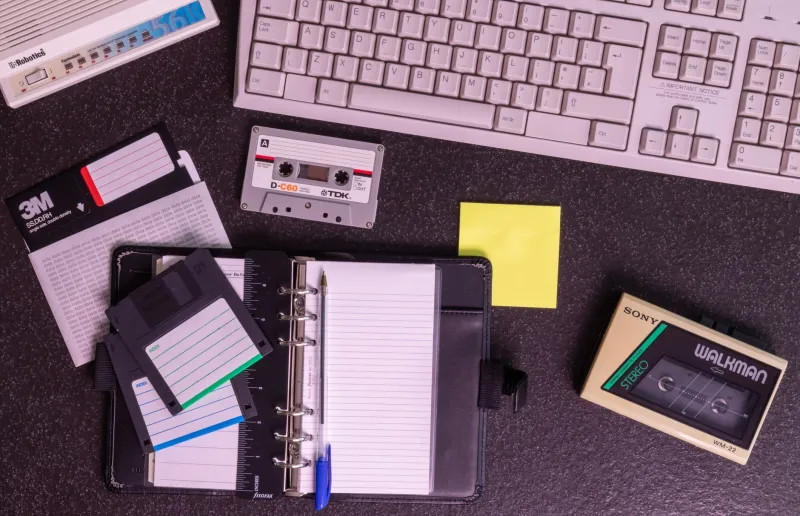
Very few objects pull that off. The rotary phone doesn't appear as a universal icon. Neither does the cassette tape, the VHS cassette, or the Zip drive (poor Zip drive). The floppy disk is genuinely special in this regard — it achieved a kind of symbolic immortality that its engineers almost certainly never anticipated.
For collectors, that dual existence adds a layer of meaning to the physical object. When you hold a factory-sealed box of Sony 3HD diskettes from 1994, you're not just holding a storage medium. You're holding the origin story of an icon that billions of people recognize without fully understanding. There's something genuinely cool about that.
How to Start Hunting
If this has you suddenly eyeing that junk drawer or garage shelf differently, here's a quick-start guide. Estate sales and thrift stores in areas with older populations — particularly those near former tech corridors like Silicon Valley, Research Triangle, or Route 128 outside Boston — are still reliable hunting grounds. Flea markets in the Midwest often turn up sealed boxes of colored diskettes that were never used.
Online, eBay remains the primary marketplace, but it pays to get specific with your search terms. "Translucent floppy disk," "promotional diskette," and "Apple floppy NOS" (new old stock) tend to surface the more interesting listings. Retro tech forums and Discord communities are also worth joining — members frequently post finds before they hit the open market.
Condition matters enormously. A sealed box is worth multiples of a loose, used disk. Original packaging, if present, adds significant value. And for the branded promotional stuff, provenance helps — a disk that came from a known collection or a documented source is more desirable than one that just appeared at a garage sale.
The Vault Verdict
The floppy disk is one of those rare tech artifacts that transcended its function so completely that it's now more culturally significant after its death than it ever was during its life. That's a strange, wonderful thing — and it makes physical examples of the format worth paying attention to.
The icon on your save button has a real-world origin. Somewhere out there, someone manufactured the object it's based on. And if you find a nice sealed box of neon-pink Sony diskettes at a thrift store for two bucks, you should absolutely buy them.
Future you will thank present you. That's just good saving strategy — in every sense of the word.